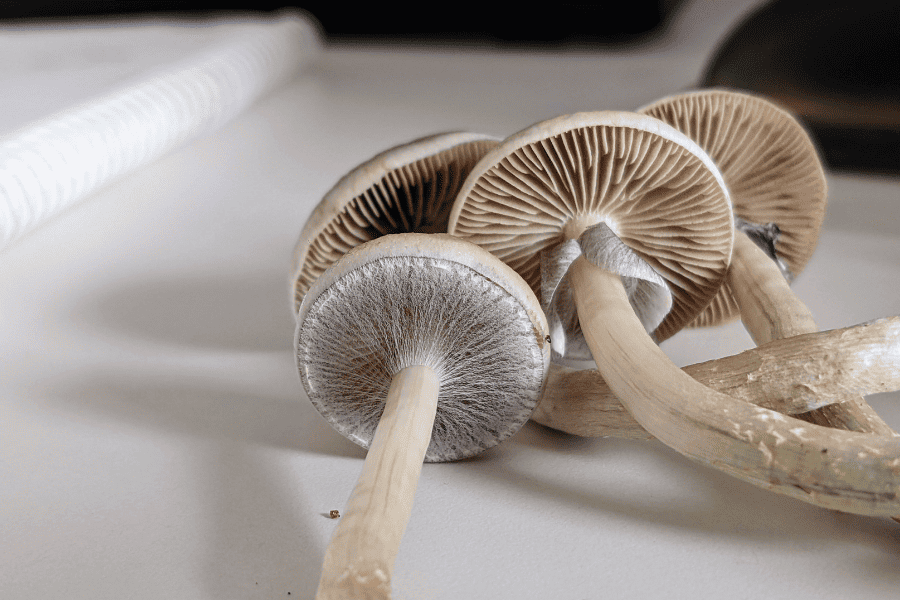
Magic mushrooms exist in an incredible range of shapes, colours, and potencies. More than 200 known species contain psilocybin—the psychoactive compound responsible for psychedelic effects. While some mushrooms produce intense hallucinations, others offer gentler, uplifting experiences. In this guide, we’ll explore the most notable psilocybin-containing species, focusing especially on those within the Psilocybe genus, which is the most widely used around the world.
Although mushrooms like Amanita muscaria (Fly Agaric) can produce powerful psychoactive effects, they do not contain psilocybin. Because of their distinct chemistry (muscimol and ibotenic acid), they fall into a different category altogether. For clarity and safety, this guide focuses exclusively on psilocybin-containing magic mushroom species.
Different Types of Magic Mushrooms
Most psychedelic mushrooms belong to the Hymenogastraceae family, which includes the well-known Psilocybe genus. Mushrooms are classified using two key levels:
Genus – A broader group (e.g., Psilocybe)
Species – A specific type within that genus (e.g., Psilocybe cubensis)
Across the world, psychedelic mushrooms are commonly categorized into seven major genera:
Psilocybe
Gymnopilus
Copelandia
Panaeolus
Hypholoma
Galerina
Mycena
Because Psilocybe mushrooms are the most widely cultivated, researched, and consumed, the species below focus on the most potent and historically significant members of this genus.
7 Most Potent Species in the Psilocybe Genus
1. Psilocybe subaeruginosa
Psilocybe subaeruginosa is considered one of the strongest psilocybin mushrooms in the world. Found primarily in Australia and New Zealand, it contains exceptionally high concentrations of psilocybin—often around 1.93%, making it several times stronger than many common species.
2. Psilocybe azurescens
Known as the Flying Saucer Mushroom, Psilocybe azurescens thrives along the Pacific Northwest coastline, including parts of British Columbia and Oregon. With extremely high alkaloid content, it produces intense and long-lasting effects.
3. Psilocybe serbica
Psilocybe serbica is a potent wood-loving species native to Central Europe. It grows in dense clusters and is recognized for its strong blue bruising reaction—an indicator of high psilocybin content.
4. Psilocybe semilanceata
Often called Liberty Caps, P. semilanceata is one of the most globally distributed psychedelic mushrooms. Despite its small size, it is highly potent and historically significant.
5. Psilocybe baeocystis
Nicknamed Bottle Caps, P. baeocystis is native to the Pacific Northwest and contains a notable combination of psilocybin, psilocin, and baeocystin.
6. Psilocybe cyanescens
Commonly known as Wavy Caps, P. cyanescens grows on woodchips and mulch beds and is recognized for its distinctive rippling cap edges and strong potency.
7. Psilocybe cubensis
Psilocybe cubensis is the most widely cultivated and accessible magic mushroom species. While less potent than some wild species, it offers consistent effects and exists in dozens of well-known strains.
Popular strains include Golden Teacher, B+, Cambodian, Mazatapec, Penis Envy, and Albino varieties.
The Final Word
The diversity of psilocybin mushrooms is vast—ranging from ultra-potent wild species to beginner-friendly cultivated strains. Understanding the differences between species helps ensure safer dosing, better preparation, and more intentional experiences.
If you’re exploring responsibly sourced options, browse:
 Discreet shipping across Canada
 Same-day GTA delivery · free over $129
 Rated 4.8+ out of 5 by our customers
 Free gift on every $60+ order